Index Lifecycle
JanusGraph uses only indexes which have status ENABLED to answer queries.
When the index is created it will not be used by JanusGraph until it is enabled.
After the index is build you should wait until it is registered (i.e. available) by JanusGraph:
//Wait for the index to become available (i.e. wait for status REGISTERED)
ManagementSystem.awaitGraphIndexStatus(graph, "myIndex").call();
After the index is registered we should either enable the index (if we are sure that the current data should not be indexed by the newly created index) or we should reindex current data so that it would be available in the newly created index.
Reindex the existing data and automatically enable the index example:
mgmt = graph.openManagement();
mgmt.updateIndex(mgmt.getGraphIndex("myIndex"), SchemaAction.REINDEX).get();
mgmt.commit();
Enable the index without reindexing existing data example:
mgmt = graph.openManagement();
mgmt.updateIndex(mgmt.getGraphIndex("myAnotherIndex"), SchemaAction.ENABLE_INDEX).get();
mgmt.commit();
Index states and transitions
The diagram below shows the possible states of an index in JanusGraph. Transitions which should be used with caution are shown in grey. These are either not recommended to be used in production scenarios or have more complex implications to be aware of.
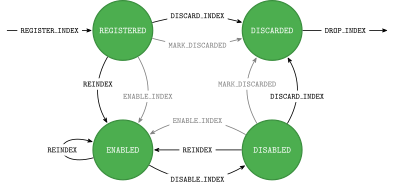
States (SchemaStatus)
An index can be in one of the following states:
- INSTALLED
-
The index has been created on the current JanusGraph instance, but it is not yet known to all instances in the cluster. Instances which already know about the index forward insertions and deletions in the graph to the index, but the index is not used to answer queries. This state is not stable in terms of synchronization between instances: waiting for the
REGISTEREDstatus is required before any reindexing decision can be made. - REGISTERED
-
The index is known to all instances in the cluster and every instance forwards insertions and deletions in the graph to the index. The index is not used to answer queries. Because all instances are guaranteed to write to the index in this state, it is safe to reindex existing data.
REGISTEREDis a transitional state:REINDEXautomatically enables aREGISTEREDindex once reindexing is finished. If the index should stay write-only instead, move it toWRITE_ONLY_ENABLEDviaENABLE_WRITE_ONLY. - WRITE_ONLY_ENABLED
-
The index is enabled for write operations only. Insertions and deletions in the graph are forwarded to the index, but the index is not used to answer queries. In contrast to
REGISTERED, this state expresses the explicit intent to keep the index write-only:REINDEXpreserves this state instead of automatically enabling the index. This is useful when building an index on a live system: the index can receive writes and be reindexed (possibly multiple times), and once it has caught up, it can be fully enabled withENABLE_INDEX— without any further reindexing. It can also be used to temporarily exclude anENABLEDindex from query answering while keeping it up-to-date, so that it can be re-enabled later without a reindex.Info
WRITE_ONLY_ENABLEDwas added in JanusGraph 1.2.0. Older JanusGraph versions cannot read schemas that contain this status, so only start using it after all instances in the cluster have been upgraded. - ENABLED
-
The index is enabled and used to answer queries. Insertions and deletions in the graph are forwarded to the index.
- DISABLED
-
The index is disabled and will not be used to answer queries. It also no longer receives graph updates, so its contents become stale over time. Therefore, it is recommended to use
REINDEXto re-enable the index. - DISCARDED
-
The index has been decommissioned and its contents have been deleted. The only remaining artifact is the schema vertex representing the index.
Note
Writes reach an index in the INSTALLED, REGISTERED, WRITE_ONLY_ENABLED and ENABLED states. Queries are
answered only by indexes in the ENABLED state. Earlier versions of this page stated that only ENABLED indexes
receive updates; that was never the case — forwarding writes while an index is INSTALLED/REGISTERED is what
makes the register-then-reindex workflow lossless.
Actions (SchemaAction)
The following actions can be performed on an index to change its state via mgmt.updateIndex():
- REGISTER_INDEX
- Registers the index with all instances in the cluster.
After an index is installed, it must be registered with all JanusGraph instances.
A
DISABLEDindex can also be re-registered: this is the required activation step before reindexing a previously disabled index, because reaching theREGISTEREDstatus guarantees that all instances write to the index again. - ENABLE_WRITE_ONLY
- Enables the index for write operations only (state
WRITE_ONLY_ENABLED). The index receives updates during graph mutations and reindexing, but is not used to answer queries. This action can be applied to aREGISTEREDindex (deferred enablement) or to anENABLEDindex (demotion: stop using the index for queries while keeping it up-to-date). It cannot be applied to aDISABLEDindex directly — re-register the index first (REGISTER_INDEX), otherwise there would be no guarantee that all instances write to the index before a subsequent reindex starts. - REINDEX
- Re-builds the index from the ground up using the data stored in the graph.
Depending on the size of the graph, this action can take a long time to complete.
Reindexing is possible in all stable states and automatically enables the index once finished, with one exception:
if the index is in the
WRITE_ONLY_ENABLEDstate, reindexing keeps it inWRITE_ONLY_ENABLEDinstead of automatically enabling it for queries. For a mixed index, the index counts as write-only if any of its keys has theWRITE_ONLY_ENABLEDstatus. - REMOVE_STALE_ENTRIES
-
Removes stale index entries: entries which reference elements that no longer exist in the graph (see Consistency during status transitions). This action complements
REINDEX: a reindex restores missing entries for existing elements but never removes entries, while this action removes entries of deleted elements but never adds entries. The index status is not changed by this action. Only global graph indexes are supported. For a composite index the internal index store is scanned. For a mixed index the documents are enumerated through exists-queries against the index backend, which requires at least one index field whose data type supports exists queries; fields that do not support them are skipped with a warning. The returned metrics report the number of removed entries under the custom metricstale-entries-removed.Warning
If custom vertex ids are used, deleting a vertex and re-creating it under the same custom id concurrently with a running
REMOVE_STALE_ENTRIESjob can remove the index entries of the re-created vertex. Run the cleanup during periods in which custom ids are not recycled, or runREINDEXafterwards to restore such entries. With automatically assigned ids this race cannot occur because ids are never reused. - ENABLE_INDEX
- Enables the index so that it can be used by the query processing engine.
An index must be registered before it can be enabled.
If enabling the index manually instead of performing a reindex, be aware that past modifications of the graph are
not represented in the index. This concern does not apply when enabling a
WRITE_ONLY_ENABLEDindex that has been reindexed, because such an index keeps receiving all writes. Enabling a previously disabled index may cause index queries to return ghost vertices:REINDEXrestores missing and outdated entries for elements that still exist, but it cannot remove stale entries for elements that were deleted while the index was disabled (see Consistency during status transitions). - DISABLE_INDEX
- Disables the index temporarily so that it is no longer used to answer queries.
The index also stops receiving updates in the graph.
An index can also be disabled within the same management transaction that creates it. Such an index is known to
all instances (after the schema change has propagated) but never receives any writes, which allows index
definitions to be rolled out long before they are activated via
REGISTER_INDEX. - DISCARD_INDEX
- Removes all data from the index, preparing it for removal. This operation is supported for all composite indices and for some mixed index backends. For more information on index removal see Removal.
- MARK_DISCARDED
- All indices which can not be discarded using DISCARD_INDEX have to be discarded manually in the backend. As this is not recognized by JanusGraph automatically, the state can be set to DISCARDED manually via this action.
- DROP_INDEX
- Removes the index from the schema and communicates the change to other instances in the cluster. After an index has been dropped, a new index is allowed to use the same name again.
Consistency during status transitions
Index status changes propagate asynchronously through the cluster: after a management transaction commits a status change, every other instance applies it only once it has processed the corresponding cache eviction. During this propagation window, instances may briefly disagree about the status of an index and therefore about whether graph mutations have to be forwarded to it.
The index lifecycle is designed so that this window cannot cause missing entries in an index that is taken through
the documented workflows: an index receives writes from the moment an instance learns about it (INSTALLED), and the
REGISTERED status is only set after all instances have acknowledged the index. Once REGISTERED is reached,
every instance is guaranteed to forward mutations to the index, so a REINDEX executed after awaiting REGISTERED
restores every element that was added or modified before or during the propagation window.
Deletions behave differently: an instance can only delete an entry from an index it already knows about. If an
element is deleted during a propagation window by an instance that does not yet know the index (or that already
considers the index DISABLED while other instances still write to it), the element's entry remains in the index as
a stale entry. Be aware of the following properties of stale entries:
REINDEXdoes not remove them. A reindex only adds and overwrites entries for elements that currently exist in the graph; it never visits deleted elements and cannot clean up their leftover entries.- Stale entries can surface in query results as ghost vertices. See
Ghost Vertices for the general discussion and the
read-time mitigation (
checkInternalVertexExistence()). -
Use
REMOVE_STALE_ENTRIESto remove them: it scans the index and deletes every entry whose element no longer exists in the graph. A full index heal is thereforeREMOVE_STALE_ENTRIES(removes entries of deleted elements) combined withREINDEX(restores missing entries of existing elements):mgmt = graph.openManagement(); mgmt.updateIndex(mgmt.getGraphIndex("myIndex"), SchemaAction.REMOVE_STALE_ENTRIES).get(); mgmt.commit();
The exposure is bounded: only elements deleted while a status change is propagating (typically a management-log round trip of a few seconds) can leave stale entries. If possible, perform index registration and activation during periods with few deletions.
Write-Only Index Workflows
Build an index on a live system and enable it later
When adding an index to a live system with ongoing data ingestion, the write-only workflow allows reindexing the existing data without automatically enabling the index, so that the operator decides when the index starts serving queries. No writes are missed at any point: the index receives all graph updates from the moment it is registered.
// 1. Create the index and wait for it to be registered on all instances
mgmt = graph.openManagement();
mgmt.buildIndex("myIndex", Vertex.class).addKey(mgmt.getPropertyKey("myKey")).buildCompositeIndex();
mgmt.commit();
ManagementSystem.awaitGraphIndexStatus(graph, "myIndex").call();

// 2. Enable the index for writes only
mgmt = graph.openManagement();
mgmt.updateIndex(mgmt.getGraphIndex("myIndex"), SchemaAction.ENABLE_WRITE_ONLY).get();
mgmt.commit();

// 3. Reindex existing data (the index stays in WRITE_ONLY_ENABLED after reindexing)
mgmt = graph.openManagement();
mgmt.updateIndex(mgmt.getGraphIndex("myIndex"), SchemaAction.REINDEX).get();
mgmt.commit();

// 4. Whenever ready: fully enable the index for queries (no additional reindex is needed)
mgmt = graph.openManagement();
mgmt.updateIndex(mgmt.getGraphIndex("myIndex"), SchemaAction.ENABLE_INDEX).get();
mgmt.commit();
Temporarily exclude an index from query answering
An ENABLED index can be demoted to WRITE_ONLY_ENABLED (for example while investigating query planner issues or
index inconsistencies). The index keeps receiving all writes, so it can be re-enabled at any time without a reindex:
mgmt = graph.openManagement();
mgmt.updateIndex(mgmt.getGraphIndex("myIndex"), SchemaAction.ENABLE_WRITE_ONLY).get();
mgmt.commit();

// ... later, no reindex required:
mgmt = graph.openManagement();
mgmt.updateIndex(mgmt.getGraphIndex("myIndex"), SchemaAction.ENABLE_INDEX).get();
mgmt.commit();
Roll out an index definition without using it
An index can be created and disabled within the same management transaction. Such an index is known to the whole cluster but neither receives writes nor answers queries, so it adds no write amplification until it is activated:
mgmt = graph.openManagement();
index = mgmt.buildIndex("myIndex", Vertex.class).addKey(mgmt.getPropertyKey("myKey")).buildCompositeIndex();
mgmt.updateIndex(index, SchemaAction.DISABLE_INDEX);
mgmt.commit();
To activate it later, re-register it first (this guarantees that all instances write to the index), then reindex and/or enable it:
mgmt = graph.openManagement();
mgmt.updateIndex(mgmt.getGraphIndex("myIndex"), SchemaAction.REGISTER_INDEX).get();
mgmt.commit();
ManagementSystem.awaitGraphIndexStatus(graph, "myIndex").status(SchemaStatus.REGISTERED).call();

// Either REINDEX (automatically enables), or ENABLE_WRITE_ONLY + REINDEX + ENABLE_INDEX as shown above
mgmt = graph.openManagement();
mgmt.updateIndex(mgmt.getGraphIndex("myIndex"), SchemaAction.REINDEX).get();
mgmt.commit();